Understanding 5G SINR: PDSCH vs CSI-RS vs SSB (Article + Video)

Introduction
In 5G New Radio (NR), Signal-to-Interference-plus-Noise Ratio (SINR) plays a critical role in evaluating network performance, coverage, and user experience. Unlike 4G LTE, where SINR was mainly derived from reference signals, 5G introduces multiple SINR types, each designed for a specific purpose.
This article provides a simple and structured explanation of the three main SINR types in 5G:
- SSB SINR
- CSI-RS SINR
- PDSCH SINR
and explains why they behave differently and how they are used in practice.
1. SSB SINR (Synchronization Signal Block SINR)
SSB SINR is primarily used for coverage and mobility evaluation.
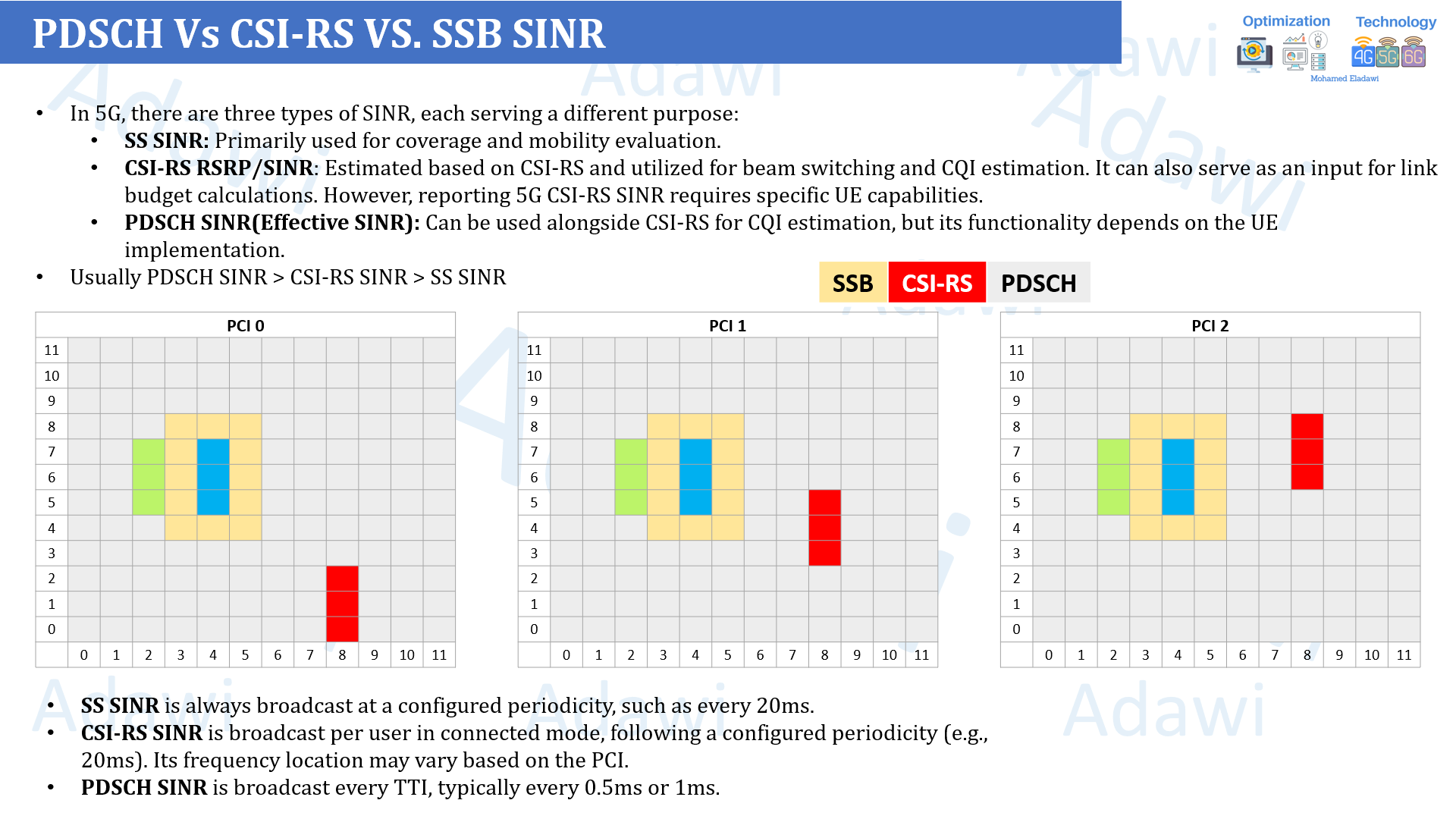
- It is broadcast periodically (typically every 20 ms).
- Used during cell search, initial access, and mobility measurements.
- The SSB is transmitted in a fixed time-frequency location, which increases the probability of interference from neighboring cells.
- Because it is always present and shared among all users, SSB SINR is usually the lowest SINR measurement.
Main use case:
Coverage evaluation, cell selection, and mobility decisions.
2. CSI-RS SINR (Channel State Information Reference Signal SINR)
CSI-RS SINR is more advanced and is mainly used for link adaptation and beam management.
- Measured using CSI-RS, which is typically configured per user in connected mode.
- Used for:
- CQI estimation
- Beam switching and beam selection
- RSRP and SINR reporting
- Link budget calculations
- CSI-RS reporting depends on UE capabilities.
- The frequency location of CSI-RS can vary based on PCI, reducing collision and interference.
Because CSI-RS is on-demand and UE-specific, its SINR is generally higher than SSB SINR.
Main use case:
Channel quality reporting and radio link optimization.
3. PDSCH SINR (Effective SINR)
PDSCH SINR, also known as Effective SINR, reflects the actual quality of the user data channel.
- Measured on the Physical Downlink Shared Channel (PDSCH).
- Reported every TTI (typically 0.5 ms or 1 ms, depending on numerology).
- Closely represents real data transmission conditions.
- Can be used together with CSI-RS measurements for more accurate CQI estimation.
- Its usage depends on UE implementation.
Due to frequent reporting and lower interference probability, PDSCH SINR is usually the highest SINR measurement.
Main use case:
Data performance evaluation and enhanced CQI reporting.
4. SINR Comparison Summary
In most practical 5G deployments, the SINR relationship is:
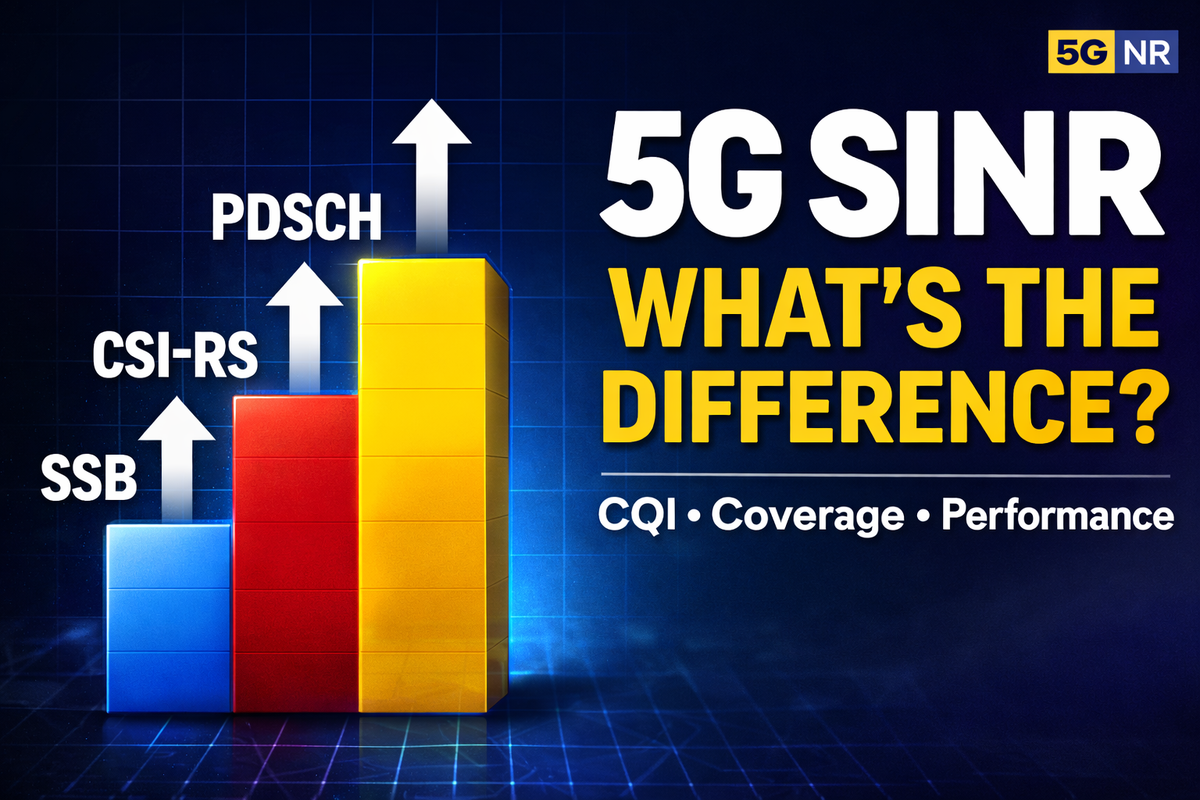
PDSCH SINR > CSI-RS SINR > SSB SINR
This difference is mainly due to:
- Reporting periodicity
- Interference probability
- Resource allocation and scheduling
- UE-specific configurations
Conclusion
5G introduces multiple SINR measurements, each optimized for a different network function:
- SSB SINR for coverage and mobility
- CSI-RS SINR for channel estimation and beam management
- PDSCH SINR for real data performance
Understanding these differences is essential for 5G RAN optimization, troubleshooting, and performance analysis. Compared to 4G, this multi-SINR approach provides greater flexibility and accuracy in evaluating network behavior.