4G LTE Cell Selection Explained: Initial Selection, Stored Information and Cell Selection Criteria


Introduction
After the UE completes system information acquisition, the next step is to determine whether the detected cell is suitable for camping.
This process is called cell selection.
During cell selection, the UE checks the available LTE cells and evaluates whether a cell satisfies the required coverage, quality, and access conditions before camping on it.
Topics Covered
- What is LTE Cell Selection?
- Types of Cell Selection
- Cell Selection Criterion
- Understanding the Main Cell Selection Parameters
- What Makes a Cell Suitable?
- Key Takeaways
(1) What is LTE Cell Selection?
Cell selection allows the UE to find and camp on a suitable LTE cell.
The UE first detects the available cells and reads the required system information. It then uses the parameters broadcast by the network, especially through SIB1, together with its own radio measurements to determine whether the cell can be selected.
The main objective is simple:
Find a cell that provides sufficient radio conditions and allows the UE to access the network.
(2) Types of Cell Selection
There are three main scenarios shown in the cell selection procedure.
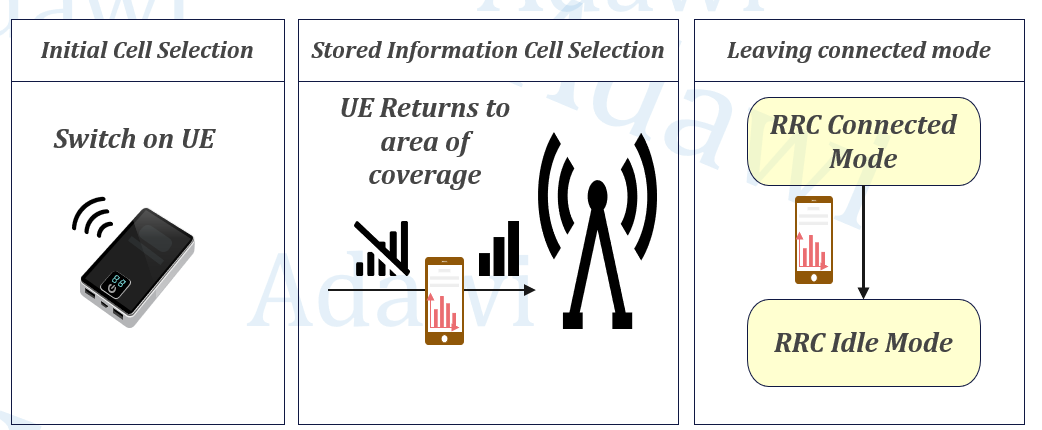
Initial Cell Selection
Initial cell selection is used when the UE does not have prior information about available LTE cells.
For example, when the UE is switched on for the first time in an area, it may need to:
- Scan the available RF carriers.
- Detect LTE cells.
- Read the required system information.
- Evaluate which cell satisfies the selection criteria.
Because the UE has no prior knowledge, this process may require more scanning.
Stored Information Cell Selection
If the UE already has information about previously detected carriers or cells, it can use this stored information to speed up the selection process.
A common example is when the UE:
- Loses coverage.
- Later returns to an area where coverage is available again.
- Tries previously known carriers/cells first.
This can reduce the time required for cell selection because the UE does not immediately need to scan all possible RF carriers.
If the stored information does not lead to a suitable cell, the UE can proceed with the normal initial cell selection process.
Cell Selection When Leaving RRC Connected Mode
Cell selection can also occur when the UE moves from:
RRC Connected Mode → RRC Idle Mode
In this case, the network may provide information in the RRC Connection Release message to redirect the UE toward a specific carrier.
This helps guide the UE toward the preferred frequency after leaving connected mode.
[Figure 1: LTE UE cell selection overview showing initial selection, stored information selection, connected-to-idle selection, S-criterion, and suitable-cell requirements — insert here]
(3) Cell Selection Criterion
After detecting a cell and reading the required system information, the UE needs to determine whether the radio conditions are sufficient for cell selection.
Two main criteria can be considered:
- Srxlev → Received signal level criterion.
- Squal → Received signal quality criterion.
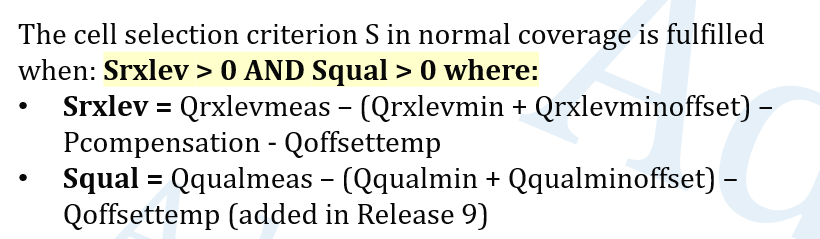
The cell selection criteria are fulfilled when:
Srxlev > 0
and
Squal > 0
Srxlev Calculation
The received-level criterion is calculated as:
Srxlev = Qrxlevmeas - (Qrxlevmin + Qrxlevminoffset) - Pcompensation - Qoffsettemp
Qrxlevmeas represents the signal level measured by the UE.
The measured value is compared against the minimum level configured by the network, while additional offsets and UE transmit-power limitations can also affect the result.
Squal Calculation
The quality criterion is calculated as:
Squal = Qqualmeas - (Qqualmin + Qqualminoffset) - Qoffsettemp
Qqualmeas represents the measured cell quality, based on RSRQ.
The Squal criterion was introduced in 3GPP Release 9.
(4) Understanding the Main Cell Selection Parameters
| Parameter | Meaning | Practical Role |
|---|---|---|
| Srxlev | Cell selection RX level value | Indicates whether the received signal level is sufficient |
| Squal | Cell selection quality value | Indicates whether the received signal quality is sufficient |
| Qrxlevmeas | Measured RSRP | Actual signal level measured by the UE |
| Qrxlevmin | Minimum required RX level | Defines the minimum acceptable signal level |
| Qrxlevminoffset | Offset applied to Qrxlevmin | Additional offset used under specific conditions |
| Qqualmeas | Measured RSRQ | Actual radio quality measured by the UE |
| Qqualmin | Minimum required quality level | Defines the minimum acceptable radio quality |
| Qqualminoffset | Offset applied to Qqualmin | Additional quality offset under specific conditions |
| Qoffsettemp | Temporary offset | Can temporarily make cell selection more restrictive |
| Pcompensation | UE power compensation | Accounts for UE uplink transmit-power limitations |
Pcompensation
Pcompensation considers the difference between the maximum transmit power allowed by the cell and the UE transmit-power capability.
It is calculated as:
Pcompensation = MAX(PEMAX - PUMAX, 0)
Where:
- PEMAX = Maximum allowed UE transmit power within the cell.
- PUMAX = Maximum transmit-power capability of the UE.
If the UE has insufficient uplink transmit-power capability, Pcompensation makes the cell-selection requirement more restrictive.
(5) What Makes a Cell Suitable?
Passing the radio-level calculation alone does not automatically mean that the UE can camp on the cell.
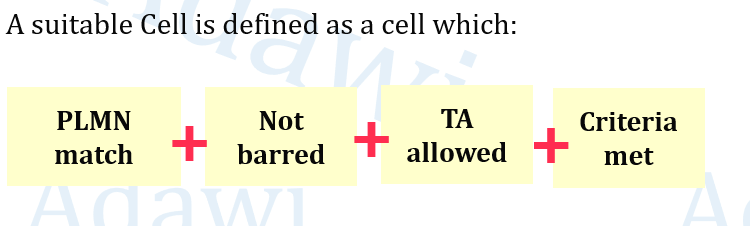
A suitable cell must satisfy several conditions:
PLMN Match + Cell Not Barred + Tracking Area Allowed + Cell Selection Criteria Met
PLMN Match
The cell must belong to a PLMN that the UE is allowed to use.
Cell Not Barred
The UE checks the cell barring information broadcast by the network.
A barred cell cannot normally be selected for camping.
Tracking Area Allowed
The Tracking Area must not be restricted for the UE.
The required information is obtained from the system information broadcast by the cell.
Cell Selection Criteria Met
Finally, the radio conditions must satisfy the required Srxlev and, when applicable, Squal criteria.
Once all these conditions are satisfied, the cell can be considered a suitable cell, and the UE can camp on it and proceed with normal network access.
Key Takeaways
- Cell selection happens after the UE acquires the required system information.
- Initial cell selection scans available RF carriers when no prior information is available.
- Stored information cell selection uses previously known carrier/cell information to speed up the process.
- The network can also redirect the UE toward a specific carrier when moving from RRC Connected to RRC Idle mode.
- Srxlev evaluates the received signal level.
- Squal evaluates the received signal quality.
- A suitable cell must satisfy the radio criteria and also be allowed from PLMN, cell-barring, and Tracking Area perspectives.
YouTube Video for the same
References
- 3GPP TS 36.304 — E-UTRA; User Equipment (UE) procedures in idle mode
- LTE in Bullets