RACH CBRA/CFRA Call Flow and Use Cases

Overview
The Random Access procedure can be initiated in different situations depending on whether the network already knows the UE and whether dedicated resources can be assigned.
Random Access Channel, or RACH, is used whenever the UE needs to establish or recover uplink synchronization with the network.
In 5G, Random Access can generally be divided into two main procedures:
- CBRA — Contention-Based Random Access
- CFRA — Contention-Free Random Access
The main difference is how the Random Access Preamble is selected.
With CBRA, the UE selects a preamble from the available configured pool, so more than one UE may select the same preamble.
With CFRA, the network assigns a dedicated preamble to the UE, significantly reducing the possibility of contention.
In 5G NSA, RACH can also appear after procedures such as SgNB Addition, while in 5G SA it is involved in procedures such as initial RRC access.
Topics Covered
- Where Is RACH Used?
- CBRA — Contention-Based Random Access
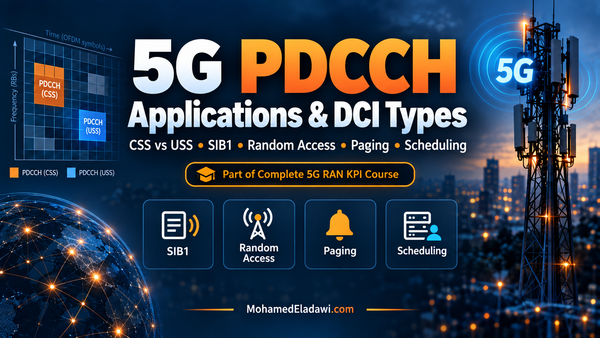
- Why RACH Can Consume PDCCH Resources
- CFRA — Contention-Free Random Access
- CBRA vs CFRA
- Key Takeaways
1. Where Is RACH Used?
Random Access is not limited to initial network access. It can be triggered by several different procedures.
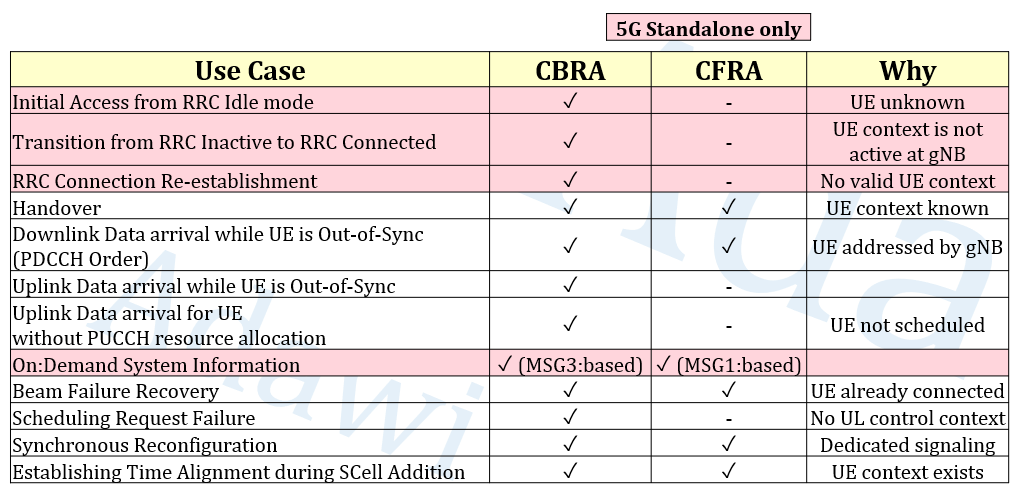
Some of the main use cases discussed in the video include:
| Procedure | CBRA | CFRA |
|---|---|---|
| RRC_IDLE → RRC_CONNECTED | Yes | No |
| RRC_INACTIVE → RRC_CONNECTED | Yes | No |
| RRC Re-establishment | Yes | No |
| Handover | Yes | Yes |
| Downlink data arrival requiring Random Access | Yes | Yes |
| Uplink data arrival requiring Random Access | Yes | No |
| On-demand System Information | Yes | Yes |
| Beam Failure Recovery | Yes | Yes |
| Scheduling Request failure | Yes | No |
| Reconfiguration / time-alignment-related procedures | Yes | Yes |
Some of these procedures are mainly related to 5G SA, particularly RRC_IDLE/RRC_INACTIVE transitions and on-demand System Information.
Handover is an important example where either CBRA or CFRA may be used depending on the implementation and configuration.
During handover, the network already has information about the UE. This gives the target gNB the possibility of assigning a dedicated Random Access preamble and therefore using CFRA.
2. CBRA — Contention-Based Random Access
With Contention-Based Random Access, the procedure is initiated by the UE without receiving a dedicated preamble assignment from the gNB.
The UE already knows the applicable RACH configuration from the network configuration it received earlier.
It then selects a Random Access preamble from the configured preamble pool.
The important point is that the preamble is not dedicated to that UE.
This means two or more UEs may select the same preamble at approximately the same time, creating contention.
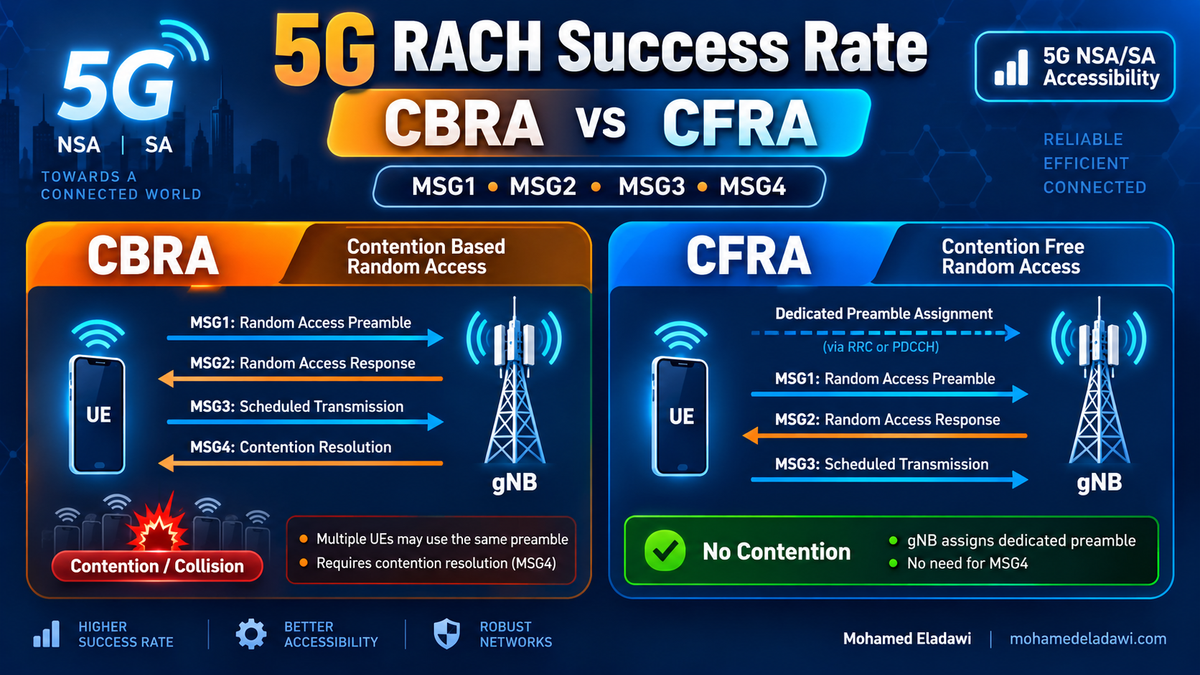
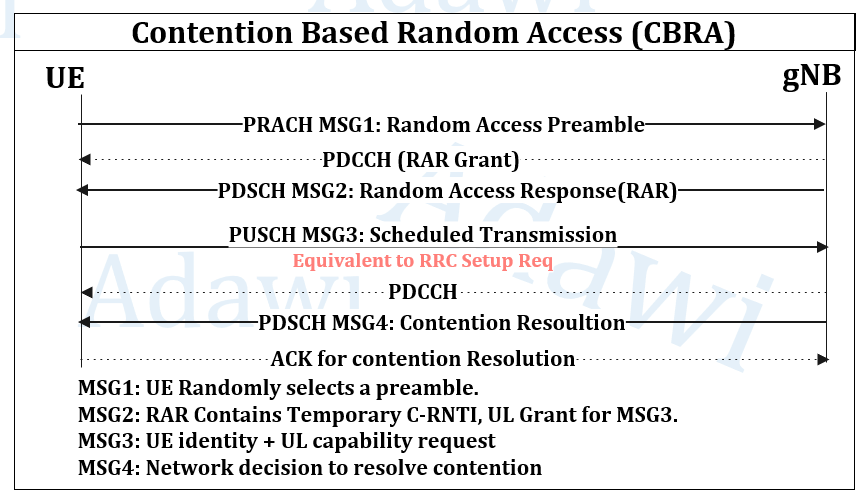
CBRA Call Flow
The basic CBRA procedure can be represented as:
UE → Msg1 → gNB → Msg2 → UE → Msg3 → gNB → Msg4
Let's look at each message.
Msg1 — Random Access Preamble
The UE starts the Random Access procedure by transmitting Msg1, the Random Access Preamble.
The UE selects one of the available configured preambles.
For example, the available preamble indices may be within the range:
0 to 63
Because the UE is selecting from a common pool rather than using a dedicated preamble, another UE may potentially select the same one.
That is where contention can start.
Msg2 — Random Access Response
If the gNB successfully detects Msg1, it responds with Msg2 — Random Access Response (RAR).
Before the UE can decode the Random Access Response, it needs to know where the corresponding downlink transmission is scheduled.
This introduces an important connection between RACH and PDCCH resource consumption.
The downlink control information provides the scheduling information required for the UE to locate and decode the Random Access Response.
The Random Access Response then provides information needed for the following steps, including:
- A temporary UE identifier
- Timing-related information
- An uplink grant for Msg3
This uplink grant is particularly important because Msg3 will be transmitted on uplink resources.
Msg3 — Scheduled Transmission
After receiving Msg2, the UE sends Msg3 using the uplink resources allocated by the network.
Msg3 is transmitted through the uplink shared channel.
During initial access, for example, this stage may carry the RRC message required to continue the connection establishment procedure.
The UE therefore does not independently select the Msg3 uplink resources. The required uplink grant was already provided through Msg2.
Msg4 — Contention Resolution
This is the message that makes CBRA particularly different from CFRA.
Because multiple UEs may have selected the same Random Access preamble, the network needs a mechanism to resolve that contention.
Msg4 performs Contention Resolution.
The network identifies which UE can successfully continue the procedure.
If another UE was involved in the same contention and does not successfully resolve it, that UE may need to repeat the Random Access procedure.
3. Why RACH Can Consume PDCCH Resources
One point that is easy to overlook during RACH analysis is the dependency on PDCCH resources.
After Msg1 is detected, the network has to schedule the corresponding Random Access Response.
The UE therefore needs downlink control information telling it where the response can be found.
As the amount of Random Access activity increases, the control-channel resources associated with these procedures can also become relevant.
This is important when troubleshooting or optimizing PDCCH utilization, because Random Access procedures are one of the applications consuming PDCCH resources.
4. CFRA — Contention-Free Random Access
The basic idea of Contention-Free Random Access is different.
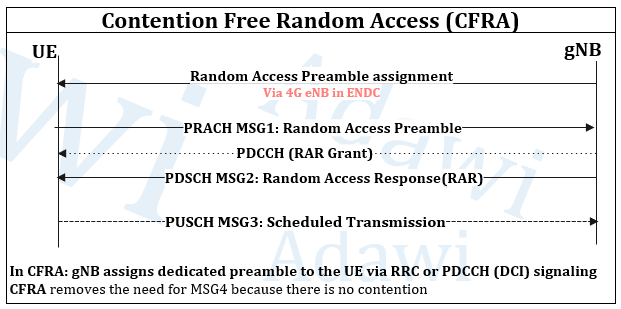
Instead of allowing the UE to independently select a preamble from the common pool, the gNB assigns a dedicated Random Access preamble to the UE.
The procedure therefore starts with an instruction from the network.
Conceptually:
gNB → Dedicated Preamble Assignment → UE → Msg1 → gNB → Msg2
The dedicated preamble may be assigned through network signaling such as RRC or applicable downlink control signaling depending on the procedure.
Dedicated Preamble Assignment
The gNB effectively tells the UE:
Use this specific preamble when you perform Random Access.
The UE therefore does not randomly choose from the normal contention-based pool.
The network knows which preamble was assigned to that UE, substantially reducing the possibility that another UE will use the same preamble for that procedure.
Msg1 — Dedicated Random Access Preamble
The UE then sends Msg1 using the assigned dedicated preamble.
This is the key difference from CBRA:
CBRA: UE selects a preamble from the available pool.
CFRA: gNB assigns the preamble to the UE.
Msg2 — Random Access Response
After detecting the dedicated preamble, the gNB sends the Random Access Response.
The procedure can then continue with the signaling required by the particular use case.
The important difference is that the Random Access procedure does not require the same contention-resolution mechanism used in CBRA.
There is therefore no need for a Msg4 contention-resolution step for the dedicated-preamble access itself.
5. CBRA vs CFRA
The main difference can be summarized very simply:
| Item | CBRA | CFRA |
|---|---|---|
| Full Name | Contention-Based Random Access | Contention-Free Random Access |
| Preamble selection | UE selects from configured pool | gNB assigns dedicated preamble |
| Contention possibility | Yes | Very low / avoided by dedicated assignment |
| Contention Resolution | Required when contention occurs | Not required for dedicated-preamble access |
| Msg4 | Used for contention resolution | Not required |
| Typical example | Initial access | Handover |
| Network knowledge of UE | May be limited | UE context is normally already available |
CFRA can therefore provide a more controlled Random Access procedure when the network already knows the UE and is able to allocate dedicated Random Access resources.
Handover is a good example.
Because the network already has UE context, a target gNB can assign a dedicated preamble to the UE instead of forcing it to compete with other UEs using the common contention-based resources.
6. Key Takeaways
The most important points are:
- RACH is used for more than initial access.
- Random Access can be either CBRA or CFRA.
- In CBRA, the UE selects a preamble from a configured common pool.
- Multiple UEs can potentially select the same preamble, creating contention.
- CBRA therefore includes a Contention Resolution stage.
- In CFRA, the gNB provides the UE with a dedicated preamble.
- Dedicated preamble assignment greatly reduces the possibility of contention.
- Procedures such as handover may support either CBRA or CFRA depending on configuration and implementation.
- Random Access also consumes control-channel resources, so its relationship with PDCCH utilization should not be ignored during optimization.
Understanding this basic call flow makes it much easier to analyze the detailed RACH parameters, timers, failures, and KPIs involved later in the Random Access procedure.
YouTube for the same
References
- 3GPP TS 38.321 — NR Medium Access Control (MAC) protocol specification
- 3GPP TS 38.331 — NR Radio Resource Control (RRC) protocol specification
- 5G NR in Bullets
Complete 5G RAN KPI Course
For a deeper practical understanding of 5G RAN KPIs and optimization across NSA and SA networks, you can find the complete course here:
🎓 Complete 5G RAN KPI Course — +30% Discount
https://www.udemy.com/course/5g-ran-kpi-masterclass/?couponCode=52497A14FABA439FC42B